
The Color Rendering Index (CRI) is a vital measurement for video lighting. It indicates how accurately a light source shows colors compared to natural daylight. A CRI of 90 or above guarantees vibrant and true-to-life color representation, which is necessary for high-quality video production. In contrast, a CRI below 80 may result in dull or unconvincing colors. Understanding CRI helps filmmakers select the right lighting fixtures, impacting the overall visual quality and viewer engagement. Further insights await on practical evaluation tips.
Key Takeaways
- CRI (Color Rendering Index) measures how accurately a light source reveals colors compared to natural sunlight, with a scale ranging from 0 to 100.
- A high CRI (90+) ensures vibrant and true-to-life color reproduction, essential for high-quality video production.
- Lighting with a CRI below 80 distorts colors, leading to dull visuals and affecting the emotional tone of a scene.
- High CRI lighting reduces the need for extensive post-production color correction, saving time and enhancing final video quality.
- Incorporating adjustable lighting options with high CRI supports creative flexibility and improved storytelling through accurate color representation.
What Is the Color Rendering Index (CRI)?
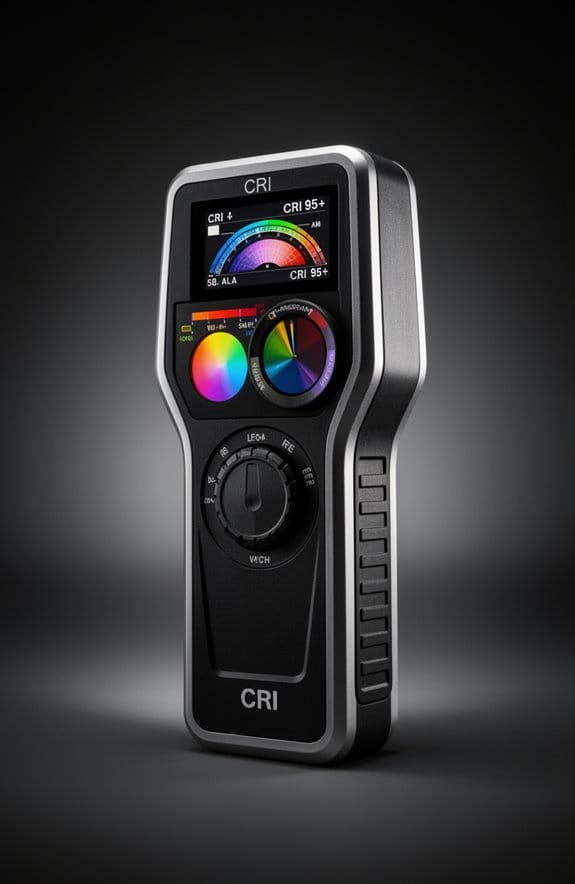
Hey there! So, let’s chat about the Color Rendering Index, or CRI—it’s pretty important when it comes to lighting. Essentially, CRI tells us how well a light source can show colors compared to natural sunlight. It uses a scale from 0 to 100, where 100 means the colors look just like they do in the sunlight. If you get below 80, though, things start to get a little tricky, and colors can look off or distorted.
Now, if you’re into photography or video production, you’ll want lights with a CRI over 90. For instance, if you’re taking photos of a sunset, you want your lighting to replicate those vibrant colors accurately so they pop in your images. It’s all about making sure that what you capture matches reality as closely as possible.
CRI is calculated by looking at how a light source spreads its color across a spectrum and comparing it to a few standard colors. This makes it easier for artists and designers to ensure that what they’re working with will look fantastic on camera. Understanding CRI can really elevate the quality of your visual work, making your projects shine even brighter. Speaking of lighting, let’s shift gears and talk about how different light temperatures can affect mood and atmosphere in a space.
Using ring lights with adjustable color temperature settings can help you achieve the best CRI effect for your photos and videos.
How Is CRI Measured?

Hey there! Have you ever wondered how the Color Rendering Index, or CRI, is actually measured? It’s pretty fascinating once you get into it. So, CRI helps us understand how well different light sources can display colors, and it’s measured using a nifty tool called a spectrophotometer. This device breaks down the light into its individual wavelengths and compares how intense they are against natural sunlight.
To give you a clearer picture, the measurement looks at eight standard color samples, labeled R1 to R8. Each of these samples represents different colors, and the results give a CRI score that ranges from 0 to 100. For example, if you have a light source with a CRI of 90 or above, it means it does a pretty great job of making colors look true to life. On the flip side, if you have a score below 80, colors might look off or dull. And don’t forget about the R9 value, which specifically shows how well reds are reproduced – it’s a big deal for overall color perception!
If you’re ever picking out light fixtures for your home or workspace, paying attention to the CRI can really make a difference in how vibrant and lively your colors appear. Plus, considering the Fidelity Index, or Rf, can give you even more insight into the quality of light you’re dealing with. So, next time you look at a light bulb packaging, keep an eye out for that CRI score! What do you think about how lighting can affect the mood and look of a space?
High CRI lights like the NEEWER 660 PRO II provide true-to-life color accuracy that can significantly enhance video and photography results.
Understanding CRI Ranges for Better Video Production

Hey there! Let’s chat about CRI ranges and how they can really boost the quality of your videos. CRI, which stands for Color Rendering Index, measures how accurately a light source reveals the true colors of objects. It ranges from 0 to 100, and if you’re aiming for true-to-life colors in your projects, you’ll definitely want to focus on values between 95 and 100—that’s where you find the most vibrant and realistic color display.
For example, if you’re filming a scene with a beautiful sunset, using lights with a CRI in that top range helps ensure the oranges and reds appear as they do in real life. On the flip side, if you’re working with lights that have a CRI below 80, you may end up with colors that look washed out or muted, which can impact the overall mood of your scene. Most filmmakers aim for lights that have a CRI of 90 or higher to keep their colors looking sharp.
Understanding CRI ranges helps you make smarter lighting choices, ensuring your visuals resonate with viewers. So, whether you’re shooting an indie film or documenting a special event, paying attention to CRI can make all the difference in how your colors come across on screen. It’s a small detail that can substantially elevate your storytelling. Why not check your lighting setups for that perfect balance? Many professional streaming light panels offer CRI ratings above 95 to guarantee vibrant and accurate colors for your video production.
Recommended Products

High CRI Chip LEDs paired with 1/2 stop soft diffusion panel

SUPERIOR BRIGHTNESS CONTROL - Achieve precise lighting with dimming from 0-100%, allowing for perfect illumination in any setting, ensuring professional-grade results every time with this LED panel.

2X2 PANEL, 2X1 SIZE - PavoSlim 240C is a 2x2 RGBWW LED panel that folds down to a 2x1 size for storage and travel and provides an impressive output of 24970 lux, 2319.7 fc @1M 5600K
Why a High CRI Matters for Quality Video Lighting
You know, high CRI lighting is super important if you want to create quality video content. When we talk about CRI, or Color Rendering Index, a score of 90 or above means that colors appear vibrant and true to life on camera. This is crucial for filmmakers, especially when it comes to capturing realistic skin tones and other visual details that really bring a story to life.
Imagine you’re shooting a close-up of someone’s face. If your lighting has a CRI above 95, you can see all those subtle color variations in their skin, making the shot feel more authentic. Plus, using high CRI lighting helps cut down on those pesky color correction sessions later on, saving you time in post-production. Additionally, incorporating lighting with adjustable tripod height can further enhance the setup by allowing versatile positioning for optimal visual effects.
Recommended Products


💡 Ultra-Bright 400W COB Output with High CRI 97+: The GVM FH400B delivers exceptional 400W COB LED brightness with up to 21,700 lux at 3.3 ft (5600K), ideal for professional film production, broadcast, and large-scale video shoots. With ultra-accurate CRI 97+ and TLCI 97+, this bi-color light ensures true-to-life skin tones and color fidelity in every frame.

Yidoblo A series is a compact, ultra-bright and high-quality LED soft light with a design focused on RGBW, color, beam field and output
How High CRI Lighting Enhances Visual Storytelling
Hey there! Let’s chat about how high CRI lighting can really make a difference in filmmaking. When filmmakers use lights with a high Color Rendering Index (CRI), like 90 or above, they’re ensuring that colors appear vibrant and true to life. This is especially important for things like skin tones; it helps them look natural on screen. Imagine how a scene in a sunlit café feels inviting when the lighting captures those warm golds and browns beautifully.
Also, high CRI lighting can really help with storytelling. For example, when a scene has dramatic tension, using well-placed high CRI lights can highlight the emotional expressions on actors’ faces, making their performances resonate more with the audience. Plus, it makes things easier during editing because color grading becomes more straightforward—what you see on the set translates well in post-production.
In the end, using high CRI lighting enriches the entire visual experience for viewers. It allows filmmakers to craft moments that not only look great but also pull the audience into the emotional heartbeat of the story. Speaking of storytelling, let’s explore how composition plays into these visuals next!
Recommended Products
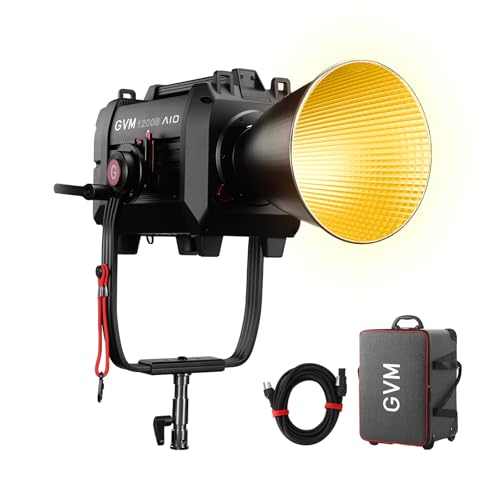
🎒Package: 1 * 1200B AIO Video Light, 1 * Power Cord, 1 * Standard Cover, 1 * Carrying Bag.

⚡Powerful All-in-One 1200W LED Monolight: This high-output 1200W COB LED features an integrated design — no bulky external ballast or controller needed. Ideal for fast-paced production environments, it delivers 42800 lux at 9.84ft, perfect for studios, TV sets, and location shoots.

GVM 1200W Ultra-Bright LED Studio Lights: This high-performance COB LED features a streamlined all-in-one design eliminating bulky external ballasts. Delivering 42,800 lux at 3m, it's perfect for studio productions, TV sets, and location shoots. The integrated system ensures quick setup and reliable output
Selecting Lighting Based on CRI Values
When it comes to lighting in film, understanding CRI values is super important. CRI, or Color Rendering Index, tells us how accurately a light source displays colors, and for video production, you really want a CRI of 90 or higher. Why? Because this ensures that colors come out just as they should, which is crucial for capturing the mood of a scene.
Now, if you can find lighting sources with CRI values between 95 and 100, you’re in for a treat! They deliver outstanding color rendering, making skin tones look natural and authentic. For instance, if you’re shooting a dramatic close-up of an actor, high CRI lighting can make all the difference, drawing the audience’s attention without any weird color distortions.
Another perk of using high CRI lighting is that it can ease the stress of post-production. With accurate colors, you won’t need to spend as much time on color correction, which is always a win in my book. Plus, if you’re a cinematographer, knowing the difference between CRI and other metrics like TLCI can help you make smarter choices for your project’s lighting setup. This not only improves the final look but also boosts the overall performance on screen.
As we navigate through different lighting techniques, understanding how to pair the right lights with your settings really enhances your storytelling. Let’s explore some specific lighting tools that can help you achieve those stunning visuals next! Also, considering the energy efficiency of LED lighting can provide long-term savings and sustainability benefits to your video projects.
Recommended Products

SUPERIOR POWER - Delivers 250W of power, ensuring ample light for various shooting scenarios, from portraits to action shots, providing consistent and reliable performance every time.

INCLUDED - Nova P600c LED Panel, Control Box, Power Cable (6m), XLR Head Cable (3m), Lightning Clamp, Rolling Hard Case & Aputure 1 Year Limited Warranty. Everything you need to get started!

Groundbreaking proprietary LED chipset: Blue, Lime, Amber, Indigo, Red (BLAIR)This groundbreaking chipset enables exceptional spectral quality, unlocking more efficient utilization of each diode’s output and unparalleled accuracy in white light reproduction
Tips for Evaluating Lighting Fixtures
When you’re diving into video production, evaluating lighting fixtures is super important. First off, let’s talk about the Color Rendering Index, or CRI for short. A CRI rating above 90 means the colors captured in your video will look true to life, which is exactly what you want. If a fixture has a CRI below 80, it might mess with the colors on screen, and that can make your footage look off. So, when you’re shopping for lights, definitely keep an eye out for the CRI listed in the specs.
But CRI is just one piece of the puzzle! You should also check the Television Lighting Consistency Index (TLCI) because this value tells you how well the light will actually perform on camera. For instance, if you’re shooting a scene with a lot of skin tones, choosing lights with a high TLCI can make a world of difference in how those tones appear. Sure, high-quality lighting might feel like a bigger expense at first, but it pays off by making your colors pop and looking realistic.
Thinking about this can really elevate the quality of your work. Plus, when your lighting is on point, it opens up so many creative possibilities for filming! So, as you look into your lighting options, keep these metrics in mind to help you create the best video possible. Many desktop ring lights also offer adjustable brightness settings that can enhance light quality for different shooting environments.
Recommended Products

【Godox SL100Bi Superior Vedio Light 】Superior lights reproduce accurate colors and thus illuminate your scene a naturally way. The Godox SL100 Bi scores over 96 on CRl and 97 on TLCl, 100W powerfull bi color light , 1M@32100 lumens, supporting that everything bathed under this light is a true-to-life show.
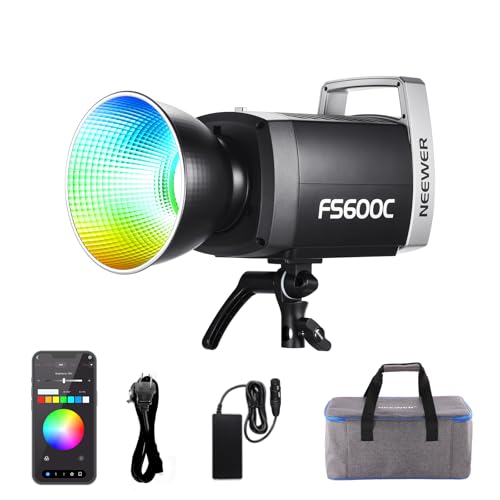
【Ultimate 600W COB Light】 The FS600C with premium LEDs and optical technology is an upgrade of the FS300, offering double output and significantly enhanced brightness up to 52,500Lux/1m (4400K, with reflector) of consistent lighting. With a portable handle, it is a key light for professional streaming, filming, portrait photo, photography, interview, videography podcast, studio photoshoot, etc. Content creator essential and influencer must have equipment kit for YouTube/TikTok video recording

【Godox SL100D Superior Vedio Light 】Superior lights reproduce accurate colors and thus illuminate your scene a naturally way. The Godox SL100D scores over 96 on CRl and 97 on TLCl, 100W powerfull daylight , 1M@32100 lumens, supporting that everything bathed under this light is a true-to-life show.
Frequently Asked Questions
Why Is CRI Important in Lighting?
CRI is paramount for lighting, ensuring exceptional color accuracy and lighting quality, elevating photography standards. In video production, it influences artistic expression, decor style, and product showcase, essential for broadcast lighting and satisfying consumer preferences during color grading.
What Is CRI and Why Is It Important?
Color Rendering Index (CRI) gauges light quality, essential for video production and photography needs. High CRI guarantees accurate colors in art reproduction, makeup application, and mood lighting, impacting furniture selection and minimizing environmental impact in lighting choices.
What Is a Good CRI Value for Lighting?
A good CRI value for lighting, ideally above 90, transforms scenes like a painter’s brush on canvas, ensuring vibrant color accuracy. This enhances film production and photography essentials, elevating visual perception in mood-setting design applications.
Is There a Big Difference Between CRI 80 and 90?
The CRI comparison reveals a significant difference between 80 and 90, affecting lighting quality and color accuracy. In video production and photography lighting, CRI 90 enhances visual perception, making colors more vibrant compared to natural light.